What is a creative technology studio?
Richard Hardy · CTO
What is a creative technology studio and when do you need one?
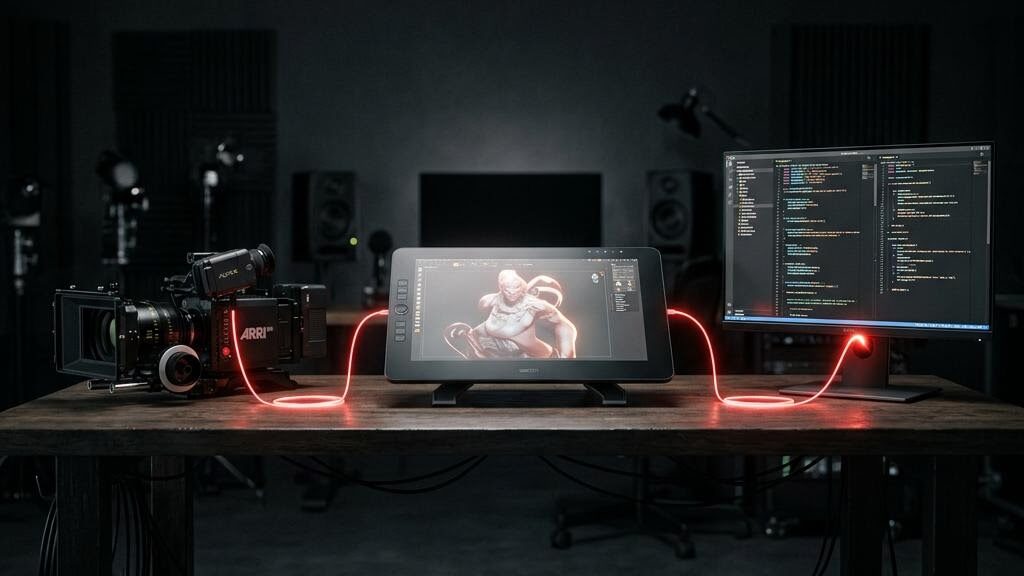
A creative technology studio is a single team that works across both creative production — animation, film, design — and engineering: platforms, business systems, applications and AI. You need one when the thing you are building has both halves in it — a platform full of content, a product that needs launching and explaining, a workflow that needs software and the material that flows through it — and you want one accountable senior team instead of an agency and a dev shop coordinating by email.
"Creative technology studio" sounds like agency wordplay, so it deserves a plain definition. It is a studio where the people who make films and animation and the people who build software are the same company, often the same room — and where projects are staffed across that whole range rather than handed between departments.
The distinction that matters
Most suppliers pick a side. Creative agencies make the film and hand you a finished asset; development companies build the system and leave the content to someone else. A creative technology studio refuses the split. At RJDM that has been a 25-year accumulation rather than a positioning exercise: founded in 2001 in Northampton, animation and film from 2006, systems and applications from 2015, consultancy from 2020, AI in the workflow from 2023. Each capability was added because client work demanded it, and none replaced the others.
What one actually does
Day to day, the work spans explainer and training animation; documentary and corporate film; client portals, dashboards and mobile apps; business systems, integrations and internal tools; AI embedded in real workflows; and the senior strategy and scoping that decides what should be built at all. The point is not the breadth for its own sake — it is that most modern briefs quietly need several of these at once. A training platform is software and animation. A product launch is film and a website and often a configurator. An AI tool is engineering and the explanation that gets a workforce to trust it.
When you need one
Three signs. First, your brief has an "and" in it: an app and its content, a system and the campaign that launches it. Second, you have been burned by the gap between suppliers — mismatched deliverables, two project managers, mutual blame. Third, you are early enough that you do not yet know whether the answer is a film, a platform or a workflow change, and you want senior people who are not incentivised to recommend the only thing they sell.
When you don't
If your need is genuinely single-discipline — a TV commercial, a staff augmentation contract, a one-off brochure site — a specialist in exactly that thing is a fine choice, sometimes the better one. Creative technology studios earn their keep on work where the disciplines have to interlock.
How to evaluate one
Ask who, by name, would work on your project, and whether the senior people you meet are the ones doing the work. Ask for examples where the creative and technical halves demonstrably shaped each other, not just co-existed on an invoice. And ask how they price: tightly scoped, fixed after scoping, with changes priced before they happen. Studios confident in both halves of their craft are usually confident enough to give you a real number.